CITEO FRANCE
MAKING REUSE A SOCIAL BADGE
CASE STUDY SUMMARY
Context:
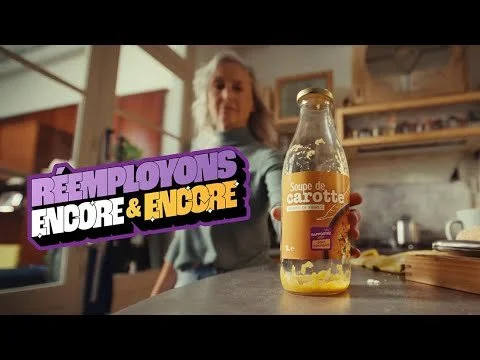
In France, the transition toward more responsible consumption is widely supported… in theory. In practice, reuse behaviours remain marginal. Despite high environmental awareness, French consumers face growing eco-fatigue, driven by the complexity of systems, economic pressure, and an accumulation of guilt-based messaging. Against this backdrop, CITEO, together with Ogilvy, launched a national TV campaign (shown above) designed to introduce and clarify the different forms of reuse, highlighting its three complementary models: bulk, refill, and reusable packaging.
In parallel, CITEO rolled out ReUse, a pilot programme for reusable packaging in the Greater North-West of France, reaching nearly 16 million people. The challenge went far beyond launching a new system: it was about supporting the long-term emergence of new consumption practices.
Problem:
Research showed that barriers to reuse were multifactorial — psychological, social, and structural. The behaviour was often perceived as constraining, marginal, or reserved for highly committed consumers. Above all, yet another narrative focused solely on environmental benefits was not sufficient to drive adoption. The core barrier was cultural: reuse lacked shared social cues to support large-scale adoption. Information alone would not be enough.
Strategy:
As the main barrier to reuse was cultural, the strategy focused on repositioning reuse as a social badge, rather than a purely ecological or functional act.
This badge was built by activating two complementary behavioural levers:
the exception effect (being among the first to adopt),
the observer effect (knowing one’s choices are visible to others).